
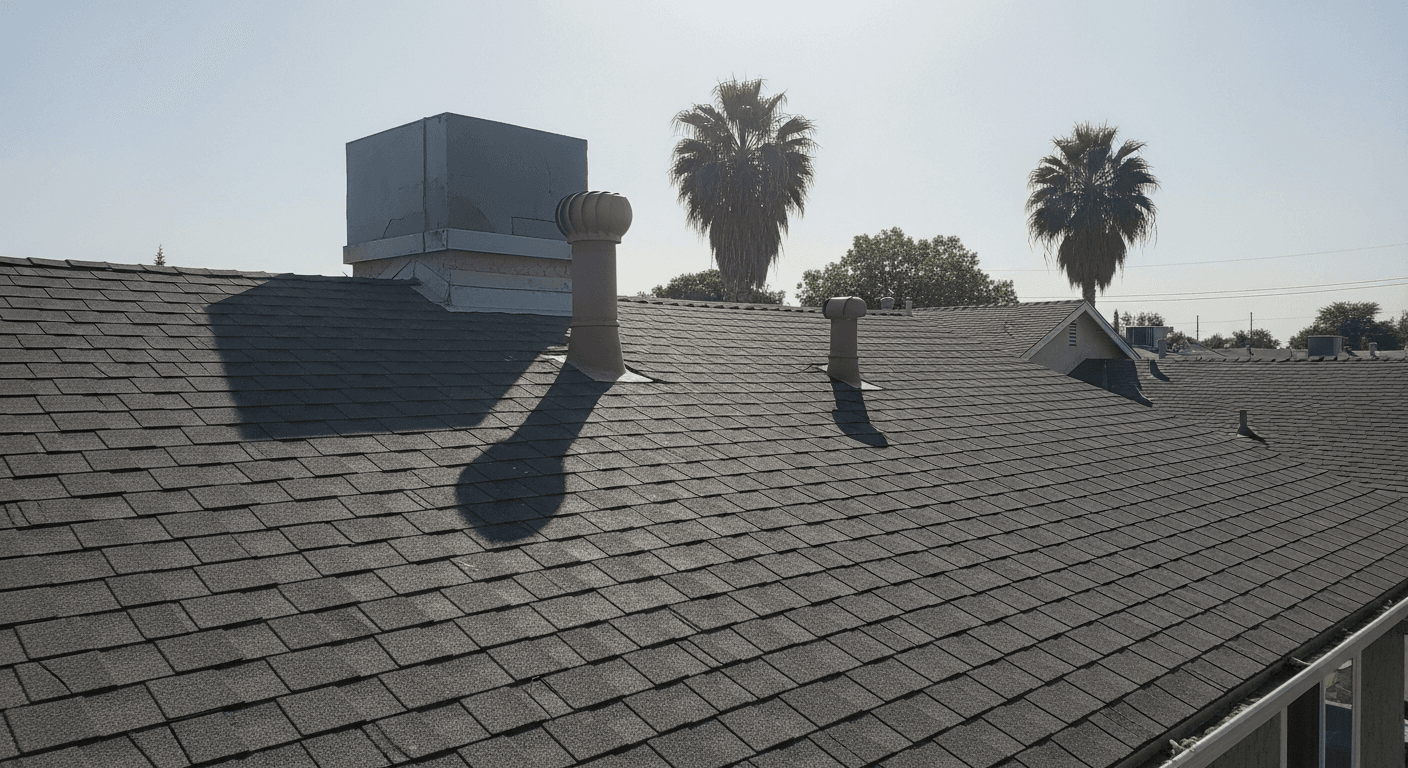
Every summer in Northern California, surface temperatures on dark asphalt shingle roofs regularly climb past 160°F. Most homeowners don't think about what that's doing to their roof — until a winter rainstorm finds the weakness that summer created. Here's what triple-digit heat actually does to your roof, what warning signs to watch for, and when to schedule a no-pressure inspection.
Why Northern California summers are harder on roofs than you think
Northern California's Mediterranean climate produces a roofing stress pattern that valley contractors have to design around but that homeowners rarely understand. From late May through September, daytime air temperatures regularly hit 95-105°F. Direct sunlight on a dark composition shingle roof pushes surface temperatures 50-70°F higher than the surrounding air, meaning your shingles routinely sit at 150°F to 165°F during peak afternoon hours.
That heat doesn't just sit on the surface. It drives down through the underlayment, into the attic, and back up at night as the air cools and the roof contracts. This cycle — expansion during the day, contraction at night — repeats every 24 hours for roughly 120 consecutive summer days. By the end of an average Northern California summer, every shingle on your roof has gone through more thermal stress than a winter-only roof experiences in an entire year.
What heat actually damages on your roof
The most vulnerable components of a Northern California roof during summer:
Asphalt shingles themselves. UV radiation breaks down the asphalt binder that holds protective granules in place. As granules loosen and fall away (collecting in gutters and at downspouts), the underlying asphalt is exposed and degrades faster. You can lose 10-15% of a shingle's protective granule layer in a single hot summer.
Sealant strips between shingles. Modern architectural shingles bond together with thermal-activated sealant. Once sealant cures, repeated heat-cycling actually starts to fatigue it, particularly at edges and rakes where shingles flex in the wind. By year 12-15, sealant in Northern California roofs is significantly weaker than in cooler climates.
Underlayment. The synthetic membrane beneath your shingles or tiles is your roof's true waterproof layer. The region's heat ages underlayment dramatically — premium synthetic underlayments lose flexibility over 15-20 summers and start to crack at fastener points. Even if your shingles look fine, an aged underlayment is a hidden leak waiting to happen during winter.
Flashing and sealant joints. Caulk and roof sealant degrade fast in heat. Around chimneys, skylights, and vent penetrations, you'll see sealant pull away from surfaces as it dries out.
Warning signs you can see from your yard
You don't need to climb on the roof to spot trouble. From the ground or a second-story window, look for:
- Granule loss — heavy accumulation of sand-like material in gutters or at the base of downspouts. Some loss is normal; piles of granules mean accelerated wear.
- Curling shingles — corners or edges of shingles lifting away from the roof surface. Heat-aged shingles lose their flexibility and start to curl.
- Cracked or split shingles — visible cracks running across individual shingles, often along the line of fastener nails.
- Discoloration patterns — dark streaks where granules have washed away, exposing the asphalt mat underneath.
- Sagging valleys — where two roof planes meet, the valley should be straight. Sagging suggests structural issues underneath.
Any one of these means it's worth scheduling an inspection before winter rain arrives.
Why summer is actually the best time to address roof issues
Most homeowners wait until they have a winter leak to think about their roof. By then, you're scheduling emergency work during the rainy season when contractors are slammed and weather creates delays. A summer inspection catches what summer damage caused — before that damage becomes a winter problem.
Summer is also when roofers can do thorough inspections. Dry weather, full daylight, and stable conditions mean we can see what's actually happening on your roof. We can document with photos, identify specific weak points, and provide written estimates without weather pressure.
What a KTN inspection actually looks like
A KTN roof inspection takes about 45-60 minutes. We climb the roof (or use drone documentation for very steep or fragile roofs), document every visible issue with photos, evaluate the underlayment condition where visible, check flashing at all penetrations, and assess gutter and downspout condition.
You get a written report within 2-3 business days with photos, identified issues, recommended repairs (if any), and a clear timeline for any work needed. There's no pressure to do work, no commission-based upselling, and no surprise pricing changes if you decide to proceed.
If your roof is in good condition, we'll tell you so. That's the honest baseline for everything we do.
Frequently asked questions
How much faster does heat damage roofs in Northern California compared to cooler climates?
Roofs in Northern California's climate typically age 25-40% faster than identical roofs in coastal or northern climates. A composition shingle roof rated for 30 years in Seattle might only deliver 20-22 years of useful life in Northern California due to UV intensity and thermal cycling.
Should I get a roof inspection every summer?
Annual summer inspections are recommended for roofs 10+ years old. Newer roofs (under 10 years) can do every 2 years. The summer inspection catches what summer damage caused — before winter rain finds the weakness.
Does a light-colored or cool-roof shingle actually help in the region's heat?
Yes. Cool-roof rated shingles use reflective granule technology that bounces solar radiation rather than absorbing it, lowering attic temperatures by 20-40°F on hot afternoons. They cost 10-20% more than standard shingles but typically pay back through reduced cooling costs within 5-7 years.
Can I see heat damage from inside my house in the attic?
Sometimes. Look for darkened wood near the roof deck, brittle or cracking underlayment visible from below, or unusually high attic temperatures (above 130°F on a hot afternoon). But many heat damage signs are only visible from above the roof itself.
Is summer heat damage covered by my homeowner's insurance?
Generally no. Insurance covers sudden damage (storms, falling trees) — not gradual wear from sun and heat. That's why catching heat-related issues early matters: small repairs are out-of-pocket but affordable, while ignored damage can lead to leak-related claims later.
Ready for a summer roof check?
If your roof is more than 10 years old and you haven't had a recent inspection, summer is the right time. KTN provides free estimates across Northern California — Roseville, Rocklin, Auburn, Lincoln, Newcastle, Grass Valley, Granite Bay, and surrounding Placer and Nevada County communities.
Want a straight answer about your roof?
Free estimates across Placer County. Written estimate within 2-3 business days. No pressure, no upsells.